


Chatib is the kind of old-school chat platform that still attracts huge curiosity because it promises instant conversation without the heavy “sign up, swipe, repeat” routine.


One minute it feels like a simple place to talk in public rooms. The next minute it can feel like a free-for-all—because open chat spaces always attract both genuine people and the usual noise.
Last Updated: February 2026
How This Chatib Review Was Evaluated
This Chatib review was evaluated using criteria that matter most for chat-with-strangers platforms and public chat rooms:
- Moderation strength: How quickly harassment, explicit content, and rule-breaking get handled
- Privacy/anonymity controls: What users can hide, limit, or protect while chatting
- Pricing transparency: Whether paid features (if any) are clear, optional, and easy to stop
- Ease of use (mobile/desktop): How smooth the experience feels across devices
- Bot/spam prevention: Whether fake users, scripted messages, and spam get reduced
- Filtering options: Tools that shape who appears (room topics, regions, interests)
- Overall user safety: Block/report tools, exit speed, and how exposed users feel
What Is Chatib?
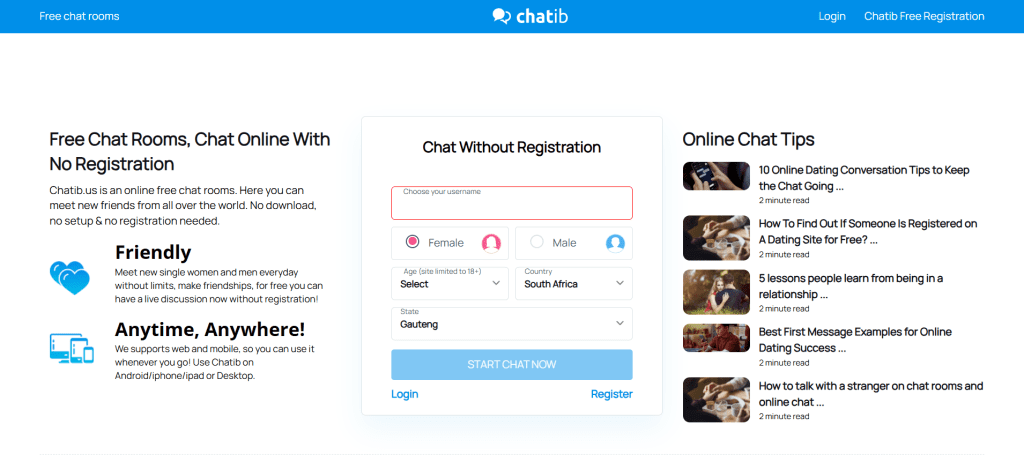
Chatib is a web-based chat service built around public chat rooms and quick private messaging. The main appeal is speed. Users typically do not need to build a profile like a dating app or spend time polishing anything. The platform’s core value is that it feels immediate—join a room, see who’s active, and start talking.
That “instant access” is also the reason expectations need to be realistic.
This type of platform is best understood as a public conversation space, not a private messaging app with strong identity verification. It can be fun, fast, and social. It can also be chaotic when rooms are open and traffic is high.
Quick answer: It’s a classic chat-room style platform designed for fast conversation with strangers, usually with minimal friction to start chatting.
What it is:
- A chat-room-first experience with public rooms and direct messages
- A fast way to talk casually, flirt lightly, or join topic-based conversation
- A low-effort alternative to social apps that require profiles and matching
What it is not:
- Not a verified community where everyone is confirmed to be real
- Not a secure private messenger designed for sensitive conversations
- Not a controlled dating environment with strong identity checks
How Chatib Works
Most users can get into a conversation quickly because the flow is simple and familiar.
1) Pick a room or entry path
Users usually start by choosing a public room or topic. Some rooms are location-themed, some are interest-based, and many are general “hangout” spaces.
2) Choose a nickname
The identity layer is often lightweight. That’s convenient, but it also means users should avoid reusing usernames connected to other accounts online.
3) Start chatting in a public room
Public rooms are the main “town square.” Messages are visible to everyone in the room. It’s easy to jump in, but it’s also easy for bad behavior to spread if moderation is weak or inconsistent.
4) Move into private messaging
Private messages can feel more personal, but they also create more risk because:
- pressure to overshare increases
- scam attempts tend to happen privately
- harassment can intensify behind closed messages
5) Use safety tools when needed
In open chat platforms, the strongest users aren’t the most patient. They are the ones who:
- exit quickly
- block early
- report consistently
- refuse to negotiate boundaries
Quick answer: The experience is fast and room-based, with private messaging layered on top—great for quick social energy, but it requires smart personal boundaries.
Key Features and Standout Tools
Even when features shift slightly depending on device or region, chat-room platforms usually succeed or fail on the same fundamentals.
Public chat rooms
- The biggest draw for users who miss the “classic chat” vibe
- Good for casual talk, jokes, banter, and quick social interaction
- Also the most likely place to encounter spam and disruptive behavior
Private messaging
- Useful for taking a conversation off the public feed
- More comfortable for longer chats
- Riskier because manipulation and scams often move to private quickly
Lightweight entry
- Minimal setup is convenient
- Also attracts low-effort users and repeat spammers
- Makes it harder to maintain consistent quality without active moderation
Room variety
- Rooms can create a sense of “finding your people”
- Topic rooms reduce random noise when they are active and well managed
- General rooms are faster but often messier
Safety tools (block/report)
- These tools matter more than anything else
- A platform can look fine on the surface, but if block/report isn’t effective, the experience degrades fast
Quick answer: The standout benefit is the immediate room-based social flow. The main weakness is that open rooms attract the same problems every public chat space attracts.
Is Chatib Anonymous?
This is where users need a practical definition.
A platform can feel anonymous because it doesn’t demand real names, detailed profiles, or social verification. But privacy is not automatic. It depends on what a user shares and how quickly they move into personal details.
What reduces anonymity fast
- Using the same nickname used on other platforms
- Sharing Instagram, WhatsApp, Telegram, or phone numbers early
- Mentioning workplace, school, or neighborhood details
- Sending photos that reveal identity, uniforms, logos, or locations
- Clicking links that lead to tracking or phishing attempts
What keeps users safer
- Use a unique nickname that is not linked to other online accounts
- Avoid sharing location specifics (“near X mall” is still specific)
- Keep early chats light and general
- Do not move off-platform quickly
- Treat every message as potentially screenshot-able
Quick answer: It can be low-identity, but it’s only “anonymous” if users actively keep it that way.
Safety, Moderation, and Privacy Controls
Public chat rooms are social by design. They’re also targets for spam, explicit content, harassment, and scams. That’s not a theory. It’s how open chat ecosystems behave when barriers are low.
The question is not whether problems exist. The question is how controllable the environment feels.
Moderation: what users should look for
- Clear rules users can actually find and understand
- Visible enforcement that discourages repeat offenders
- Reporting tools that feel immediate and not ignored
- Less spam in the room feed itself (a sign of prevention, not just cleanup)
Common risks in chat-room platforms
- Spam and bots: copy-paste messages, suspicious links, fake flirting patterns
- Harassment: aggressive behavior, insults, sexual pressure, intimidation
- Scams: money requests, “investment” pitches, gift card pressure, emergency stories
- Off-platform pulls: fast moves to WhatsApp/Telegram to remove safety controls
- Catfishing: fake identity, fake photos, inconsistent stories
Risk-reduction habits that work
- Never click links from strangers. Not even “just a funny video.”
- Avoid sharing contact info early, even if the conversation feels friendly.
- If someone pushes for money, leave immediately. No debate.
- Keep conversation in the room longer before switching to private messages.
- Use block/report fast. The platform is not owed patience.
Quick answer: In open chat ecosystems, safety is mostly personal behavior plus the ability to block and exit instantly. A user’s speed matters.
Pricing, Payments, and Subscription Structure
Many room-based chat platforms are primarily free to access. When payments exist, they usually fall into familiar categories:
- optional upgrades
- ad reduction
- extra features that improve convenience
- visibility perks or premium access areas
What matters most is not whether a platform is free. It’s whether pricing (if present) is clear and whether users can easily stop recurring charges.
Smart rules before paying
- Only pay if the feature clearly improves the user experience
- Avoid paying to “fix” quality problems caused by other users
- Review renewal terms and cancellation steps before committing
- Treat any “exclusive access” promises with caution in public chat ecosystems
Quick answer: Paid upgrades can improve convenience, but they don’t guarantee better people. Boundaries still do the heavy lifting.
User Experience (Mobile, Desktop, Sign-Up)
Chat-room platforms often live on the web first, then adapt for mobile usage patterns. The experience tends to be defined by three things: speed, readability, and control.
Sign-up and entry
- Fast entry is good for casual users
- Very low friction can increase spam traffic
- Nickname-based access is convenient but weaker for trust
Mobile experience
- Great for quick drop-in sessions
- Easier to exit fast and switch rooms
- Can feel noisy if rooms are active and the interface is tight
Desktop experience
- Better for long conversations
- Easier to follow room threads
- More comfortable for users who like typing and multi-tasking
What “good UX” looks like in this niche
- Clear room browsing
- Easy switch between public and private conversations
- Block/report not buried
- No confusion between what is public and what is private
Quick answer: The best experience is when navigation is simple and safety controls are one tap away.
Pros and Cons
Pros
- Quick access to public chat rooms and casual conversation
- Room-style format can feel more social than one-on-one matching
- Low-pressure vibe compared to dating apps
- Works well for short chats and spontaneous interaction
Cons
- Room quality can swing wildly depending on traffic and enforcement
- Spam and bot behavior can appear in open chat environments
- Private messages can increase risk if users overshare
- Not designed for serious identity trust or secure privacy by default
Chatib vs Alternatives (5–10 Options)
Not everyone wants the same style of interaction. Some users want random video chat. Others want safer community structure. Others want topic rooms with better moderation culture.
Best for fast random 1-on-1 video chat
- OmeTV – quick roulette-style matching and easy switching
- Chatspin – lightweight random video chat with optional filters
- Camsurf – often chosen for a more moderation-forward feel
- Shagle – more control tools in many regions, but quality varies
Best for better conversation fit
- Emerald Chat – more interest-driven matching style
- Discord communities – topic-based servers with stronger structure and moderation
Best for classic room-based chatting
- Wireclub-style room platforms – room-first formats, topic browsing
- Invite-link group chat/video tools – private communities with less random exposure
Quick answer: If the goal is pure chat rooms, room-based alternatives can work. If the goal is video roulette, video-first platforms are a better match. If the goal is safer community, structured servers win.
Comparison Table
| Platform | Best For | Free Version | Moderation | Key Advantage |
|---|---|---|---|---|
| Chatib | Public chat rooms + quick DMs | Yes | Medium (varies) | Fast room-based conversation |
| OmeTV | Random 1-on-1 video chat | Yes | Medium | Simple UI, quick switching |
| Camsurf | Moderation-forward roulette chat | Yes | Stronger | Safer feel, fewer repeat offenders |
| Chatspin | Roulette chats + optional filters | Yes | Medium | Lightweight and quick start |
| Shagle | Filter-heavy random video chat | Limited | Medium | More control over matching |
| Emerald Chat | Interest-based matching | Yes | Medium | Better conversation fit |
| Discord communities | Interest-based communities | Yes | Strong (server-based) | Structure + active moderation |
| Invite-link group tools | Private calls/groups | Yes | Strong | No random pool exposure |
FAQs: Chatib
1) Is it a chat room site or a dating site?
It’s primarily a chat-room style platform. People may flirt, but it’s not structured like a trhttps://randomchatty.com/wp-content/uploads/2024/12/multiethnic-team-using-green-screen-tablet-to-over-MVKF9J9.jpgional dating app.
2) Does it require a full profile to start chatting?
Usually the entry is lightweight. That’s convenient, but it also means users should be careful with what they share.
3) Can users talk privately, or only in rooms?
Many chat-room platforms support private messaging alongside public room conversation.
4) Is it actually anonymous?
It can be low-identity, but anonymity depends on user behavior. Sharing personal details removes anonymity fast.
5) Are there bots and spam in chat rooms?
Open chat rooms often attract spam. Users should watch for copy-paste messages and suspicious links.
6) What’s the safest way to use chat rooms?
Keep chats light at first, avoid contact info, never click links from strangers, and exit quickly when something feels off.
7) Why do strangers push to move to WhatsApp or Telegram?
Sometimes it’s convenience, but it’s also a common tactic used by scammers because it removes built-in reporting controls.
8) What should users do if someone becomes inappropriate?
Exit immediately, block, and report. Don’t argue and don’t try to negotiate boundaries.
9) Is it safe for minors?
Open chat platforms are not ideal for minors because public rooms can expose them to adult content, scams, and harassment.
10) Can users control who messages them?
Some control may exist through room choice and blocking, but open platforms typically offer less filtering than dating apps.
11) What are the biggest risks in chat-room platforms?
Oversharing, scams, harassment, and clicking malicious links are the most common risks.
12) What’s better for random video chat specifically?
OmeTV, Chatspin, Camsurf, and Shagle are better choices for video-first roulette chatting.
13) What’s better for safer communities?
Structured communities like Discord servers typically offer stronger moderation and clearer rules.
14) What’s the biggest mistake new users make?
They treat the space like a private conversation too quickly and share identifiers before trust is earned.
Final Verdict: Chatib
For people who want fast public chat rooms with minimal setup, Chatib can deliver quick conversation and a familiar “classic chat” feel. But open room platforms come with predictable trade-offs—spam, mixed behavior, and privacy risks if users overshare. The best experience comes from staying cautious, keeping chats light, refusing off-platform pressure, and using block/report tools instantly when needed, because that’s how users stay in control on Chatib.


