


Chat Hour sits in the “classic chat rooms” lane, not the roulette-style random video chat lane, and that single difference changes everything about expectations.



It’s built for real-time text conversations in public rooms and private messages, with a lighter, old-school feel that some users still prefer over endless swipe apps. The catch? Room quality can vary, and safety depends heavily on how a user approaches strangers online.
Last Updated: February 2026
What Is Chat Hour?
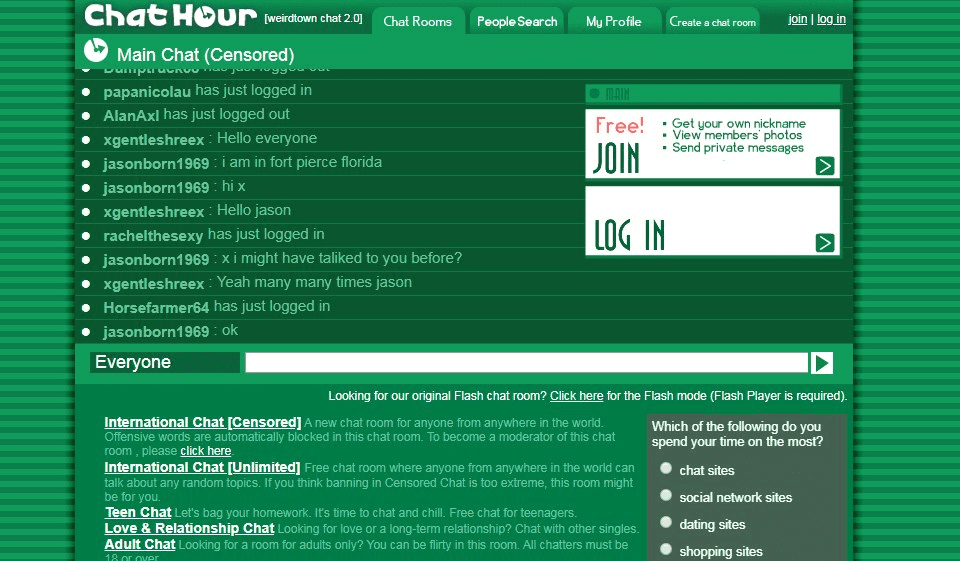
Chat Hour is a chat-room style platform where people join topic-based rooms, talk in real time, and sometimes move into one-on-one private messaging. It’s designed for quick social interaction without needing a deep profile, long onboarding, or “matching” steps that slow everything down.
What it is:
- A text-first chat environment with public rooms and private chats
- A place to meet strangers through group conversation rather than instant matching
- A lightweight, casual alternative to structured dating apps
What it is not:
- A dedicated random video chat roulette site built around cam-to-cam matching
- A verification-heavy platform where user identities are strongly confirmed
- A consistent, high-control environment across every room at every hour
A useful way to frame it: room chat is more like walking into a crowded lounge and joining the conversation. Random video chat is more like speed-meeting one person at a time.
How Chat Hour Works
The experience usually follows a simple pattern:
- Pick a room or category
Users choose a room based on topic, vibe, or audience. - Enter with a nickname and basic info
The goal is low friction. Some users create accounts, but room chat platforms often keep things simple. - Chat publicly first
Messages appear in a shared feed. In active rooms, conversations move quickly. - Move to private chat cautiously
Private messaging is where the experience can improve (real conversation) or go sideways (spam, pressure, explicit content, scams). - Use block/report tools aggressively
The fastest way to improve the experience is to mute, block, and exit early when a conversation feels off.
Here’s the reality that most users learn fast: on room-based platforms, the “best room” matters more than the platform name. One room can feel friendly and normal. Another can feel chaotic.
Key Features and Standout Tools
Most classic chat-room platforms win on simplicity, and Chat Hour is typically evaluated through that same lens:
- Public chat rooms for group conversation and fast social energy
- Private messaging to continue conversations one-on-one
- Topic-based browsing so users can choose a vibe instead of being randomly matched
- Basic identity signals like nicknames and minimal profiles
- Blocking and reporting (the most important tools for safety)
- Mobile-friendly access (room chat is often usable on phones without feeling cramped)
Room chat has a different kind of “filtering.” It doesn’t usually filter people by gender/location the way some video platforms do. Instead, users filter by choosing rooms and avoiding risky behavior patterns.
A short, direct truth: the best feature is not a button. It’s the ability to stay public, watch behavior, and choose who deserves private attention.
Is Chat Hour Anonymous?
It can feel anonymous, but most users should treat it as pseudonymous.
- Pseudonymous means people use nicknames and don’t need to present real identities.
- Anonymous implies no meaningful tracking, no enforcement, and no identity signals at all.
Even on platforms with light signup, users should assume:
- Public messages are visible to many people
- Private messages can be copied or screenshot
- Platforms can still log technical identifiers
- Moderators may have additional visibility in rooms
The safest approach is simple: anonymity is real only when personal details stay private. Once a user shares name, city, workplace, school, number, or socials, anonymity is gone.
Safety, Moderation, and Privacy Controls
This niche has two constant problems: low-effort spam and people pushing boundaries. Safety depends on moderation and user behavior working together.
What typically improves safety:
- Rooms with active moderation and visible rule enforcement
- Clear reporting flows that actually lead to action
- Users who block early and avoid private chat too soon
What usually increases risk:
- Clicking links sent by strangers
- Moving off-platform fast (WhatsApp/Telegram “right now”)
- Sharing personal details to “prove” anything
- Staying in conversations that feel manipulative, sexual, or coercive
Practical risk reduction that works:
- Stay in public rooms before going private
- Ignore anyone who sends links or asks for money
- Never share a number, location, or socials early
- Treat “verification” requests as a red flag
- Exit fast when the vibe changes
A lot of people try to be polite and end up stuck in a bad interaction. In chat environments, “leave” is a safety feature.
Pricing, Payments, and Subscription Structure
Most room-based chat platforms run on a free core experience with optional paid upgrades. Usually:
- Free use covers entering rooms and chatting publicly
- Paid features may include convenience perks, profile enhancements, message privileges, or reduced friction
When evaluating any paid layer, the key question is: does payment improve control and safety, or does it mainly boost visibility and attention?
If the paid tier mostly boosts visibility, it can attract more unwanted messages. If it improves messaging controls, privacy tools, or limits spam exposure, it may be worth it for frequent users.
User Experience (Mobile, Desktop, Sign-Up)
Chat-room platforms tend to be easy to access because they don’t rely on heavy video infrastructure. Typical experience:
- Fast entry with minimal onboarding
- Room-first interface with a scrolling chat feed
- Mobile usability that’s generally solid for text chat
Where users commonly get frustrated:
- Some rooms feel noisy or repetitive
- Spam cycles appear during peak hours
- Private messages can become messy quickly
- Quality can vary depending on time zone and room culture
Who usually enjoys this format:
- People who prefer text-first socializing
- Users who like group conversations
- Anyone who wants a casual “drop in, chat, leave” experience
Who often dislikes it:
- People who want verified identities and structured matching
- Users who want clean, instant 1-on-1 video calls
- Anyone who hates crowded feeds and random interruptions
Pros and Cons
Pros
- Text-first and low pressure
- Easy to join and start talking quickly
- Group rooms can feel social and community-driven
- Less “performance pressure” than cam-to-cam chat
Cons
- Room quality can vary widely
- Moderation may be inconsistent by room and time
- Spam and low-effort messages can appear
- Private messages can be risky without boundaries
Chat Hour vs Alternatives (Include 5–10 alternatives)
The best alternative depends on what the user actually wants: rooms, 1-on-1 video, better moderation, or interest matching.
Strong alternatives to consider:
- OmeTV – Quick 1-on-1 video matching with a huge user base
- Camsurf – Often positioned as a more moderation-forward option
- Chatspin – Roulette-style matching with optional filters
- Emerald Chat – More structure and interest-style matching
- Camgo – Simple onboarding and clean 1-on-1 flow
- Discord communities – Topic-based connection with layered moderation (not random)
- Reddit communities – Slower, safer topic discussion (not live video)
- Invite-link video tools – Private calls with no random pool exposure
A practical shortcut:
- Want instant cam-to-cam? Roulette platforms are better.
- Want room-based conversation and community? Classic chat rooms are better.
- Want safer pacing? Community platforms often win.
Comparison Table: Chat Hour vs Other Platforms
| Platform | Best For | Free Version |
Moderation | Key Advantage |
|---|---|---|---|---|
| OmeTV | Fast 1-on-1 video chats | Yes | Medium | Quick switching and big user pool |
| Camsurf | Moderation-first vibe | Yes | Medium–Stronger | Safer feel compared to wilder roulette |
| Chatspin | Roulette chats + optional filters | Yes (limited) | Medium | Lightweight and easy to start |
| Emerald Chat | Interest-based matching | Yes | Medium | More structure than pure roulette |
| Camgo | Clean 1-on-1 experience | Yes | Medium | Simple UI and fast onboarding |
| Discord communities | Topic-based communities | Yes | Varies by server | Strong moderation tools and roles |
| Reddit communities | Interest discussion | Yes | Medium–Strong | Better pacing and boundary control |
FAQs: Chat Hour
Is it a random video chat site?
It’s primarily a chat-room platform. It’s built around public rooms and text-based interaction, not instant cam-to-cam roulette.
Is an account required to use it?
Often it’s possible to enter and chat with minimal setup. Creating an account may add persistence and extra controls.
Is it good for meeting strangers quickly?
Yes, because rooms move fast and entry is simple. Quality depends on choosing the right room and time.
Is it anonymous?
It’s best described as pseudonymous. Nicknames help, but privacy depends on what a user shares.
How safe is private messaging?
Private messaging is where most risks show up. The safest approach is to stay public first and move private only after trust.
What scams are common in chat rooms?
Link traps, fake verification, urgent money stories, crypto pitches, and pressure to move off-platform quickly.
Does moderation stop bad behavior?
Moderation helps when it’s active and consistent. Some rooms will feel safer than others depending on staff presence.
Can users block people easily?
Blocking is usually available and should be used early. It’s one of the best ways to improve the experience.
Is it better on mobile or desktop?
Both can work for text chat. Desktop can feel easier for reading fast-moving rooms.
Does it have filters like gender or location?
Room platforms usually filter by room choice rather than detailed matching filters.
Why do some rooms feel spammy?
Busy hours, low moderation, and repeat spammers can flood public feeds. Switching rooms often fixes it quickly.
How can a user avoid creepy conversations?
Stay public longer, don’t overshare, block early, ignore link senders, and leave when the vibe shifts.
Is it better than Omegle-style platforms?
It depends. Chat rooms are better for group talk and lower pressure. Omegle-style roulette is better for instant 1-on-1 video.
What’s the best first-time strategy?
Enter a calmer room, observe before engaging, keep personal details private, and block quickly when someone crosses boundaries.
Final Verdict: Chat Hour
Chat rooms still have a place for users who want fast conversation without the pressure of instant video, but the experience depends on room culture, timing, and boundaries. The best results come from staying public early, avoiding links, blocking quickly, and choosing rooms that feel moderated and normal. For people who prefer text-first social energy over nonstop roulette matching, Chat Hour can be a practical option — especially when approached with common sense and clear limits, and when the goal is simple: chat, exit, repeat, and keep it safe on Chat Hour.