

Tohla sits in that classic “click and connect” category where strangers meet instantly, talk for a bit, and move on without the heavy profile-first vibe of dating apps.



The difference is that it tries to offer more than just a basic text roulette loop. It mixes 1-on-1 chat with optional modes like voice and video, and it leans into lightweight “fun” features that keep conversations from feeling dry.
Last Updated: February 2026
How This Tohla Review Was Evaluated:
This review uses a consistent checklist that matches how people actually judge random chat and cam chat platforms:
- Moderation strength (how quickly rule-breakers are handled and whether enforcement feels consistent)
- Privacy/anonymity controls (how exposed users feel and what information is required)
- Pricing transparency (clear costs vs confusing upsells or hidden limits)
- Ease of use (mobile/desktop) (speed to first chat, stability, and friction)
- Bot/spam prevention (how often bots appear and how aggressively they’re filtered)
- Filtering options (whether users can influence who appears, and how meaningful those controls are)
- Overall user safety (how easy it is to exit, block, report, and avoid scams)
What Is This Platform?
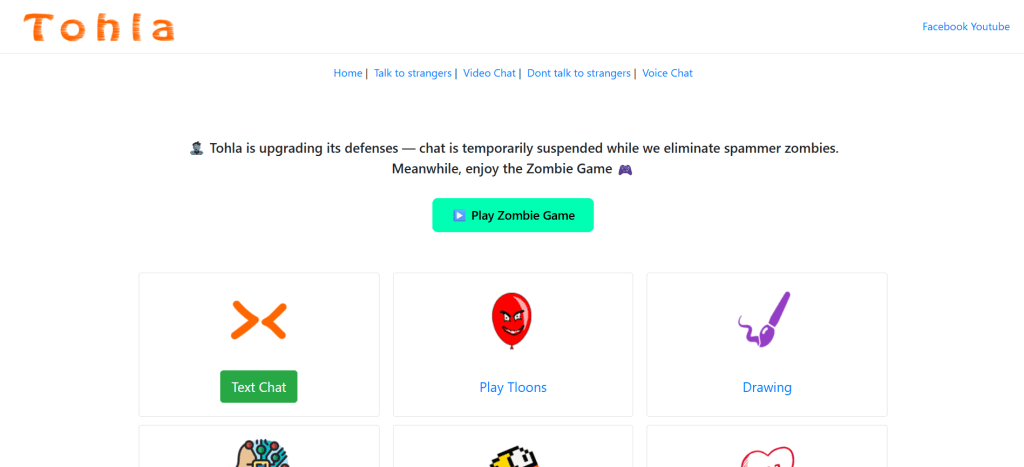
This is a stranger chat site built around random pairing. A user connects, the system picks another user at random, and both people get a private 1-on-1 session. The experience usually starts with text-first simplicity, then expands into richer formats depending on what the user chooses.
In practical terms, the platform tries to cover three common intents:
- Quick talk to kill boredom (short, disposable chats)
- Low-pressure social practice (typing first, then voice/video if comfortable)
- Flirty or playful energy (common in chat-with-strangers environments)
What it is:
A random chat platform designed for instant 1-on-1 conversations with strangers, with multiple communication modes.
What it is not:
- A profile-based dating app that optimizes for long-term matching
- A private calling tool meant for friends who already know each other
- A guaranteed “safe space” (random chat always comes with unpredictability)
A short, direct answer block that helps expectations:
Random chat platforms aren’t built for deep trust. They’re built for speed, novelty, and quick exits. The best experience comes from treating each chat as temporary and staying strict about privacy.
How the Platform Works
The main loop is straightforward: connect, chat, and move on. Where many sites stop there, this one tries to keep users engaged by offering different ways to communicate, so the experience doesn’t feel like endless typing.
A typical user flow looks like this:
- Start a session by choosing the main “connect” experience.
- Get paired randomly with another active user.
- Chat 1-on-1 with minimal setup required.
- Switch modes if the platform supports it (for example, moving from text to voice or video).
- End or skip when the conversation stalls.
- Block/report if someone crosses boundaries, spams, or behaves aggressively.
This creates a practical advantage over pure roulette text chat: users can stay text-first when cautious and only escalate to voice/video when the vibe feels normal.
A natural answer block that fits here:
The real quality marker isn’t the feature list. It’s how quickly the platform connects users and how clean the pool feels across the first 10–20 chats.
Key Features and Standout Tools
Most chat-with-strangers platforms copy the same formula. The difference comes from the little extras that reduce awkwardness and add variety.
Random 1-on-1 text chat
This is the core. It’s the simplest way to meet someone new without pressure, and it’s often the best starting point for privacy.
Voice chat option
Voice can make conversations feel more real without showing a face. For many users, it’s a comfortable middle step between text and video.
Video chat option
Video increases connection and intensity. It can also increase risk because identity cues appear immediately. For users who enjoy cam-to-cam chat, video makes the experience feel more direct.
Emojis and lightweight chat tools
Small tools like reactions and smileys matter more than people admit. They help conversations start faster and reduce the “what do I say?” friction.
Talk-to-character style mode
Some users want a break from unpredictable strangers. A character-chat mode can add entertainment value and give users something to do when the live pool feels slow.
The “connect again” loop
The ability to reset quickly is the product. If the platform makes reconnecting fast, users stay longer. If it interrupts the loop with popups or friction, users bounce.
A short answer block for quick decision-making:
The best platforms in this niche feel smooth and “quiet.” Users should be able to connect, exit, and reconnect without feeling pushed into upgrades or extra steps.
Is the Platform Anonymous?
Anonymity in random chat is always partial. The platform can avoid forcing real names or detailed profiles, but it cannot prevent users from revealing identity through behavior, background details, or moving off-platform too quickly.
Here’s how anonymity usually works in practice:
- Text chat tends to feel more anonymous because users can share less.
- Voice chat reveals more than expected (accent, age cues, emotional tone).
- Video chat reveals the most (face, environment, and recognizable context).
Even without profiles, anonymity can be lost through common mistakes:
- sharing a personal username or social handle
- discussing location too specifically
- showing identifiable items in the background
- letting the conversation move off-platform immediately
A natural answer block that belongs here:
Most “anonymous chat” experiences are only anonymous if users keep them that way. The safest approach is minimal sharing, a boring background, and treating every chat as disposable until trust is earned.
Safety, Moderation, and Privacy Controls
Safety is the biggest variable in any chat-with-strangers platform. The strongest systems reduce bad encounters and give users fast exits when things go sideways.
What strong moderation feels like
- obvious rule-breakers disappear quickly
- repeat offenders don’t keep showing up
- reporting feels like it has a result
- spam and bots are less common
What weak moderation feels like
- frequent spam links or copy-paste scripts
- aggressive users pushing boundaries repeatedly
- the same behavior appearing across many chats
- reporting feeling pointless
Privacy controls that matter most
- an immediate end/skip option
- one-tap blocking
- reporting that works mid-chat
- clear rules so users understand what crosses the line
A short answer block that helps users stay grounded:
No random chat platform can guarantee a perfect experience. The safest ones reduce repeat offenders and make it easy to exit instantly. Users still need strong boundaries—especially in voice and video modes.
Pricing, Payments, and Subscription Structure
Many platforms in this niche follow a predictable model: free entry for basic chatting, then optional upgrades for convenience or more control.
Common structures include:
Free access to start chatting
This is usually the hook. It keeps the barrier low and makes it easy for new users to test the platform quickly.
Optional upgrades
Depending on how the platform is structured at the time of use, upgrades often target:
- more control over the experience
- convenience features
- premium modes or limits removal
The “clarity test” that matters
Pricing doesn’t have to be cheap to be fair. It has to be clear. If a platform explains what’s free and what isn’t in plain language, trust improves. If pricing feels vague, users should expect paywalls to appear at the worst moments.
A natural answer block that helps readers evaluate fast:
The best pricing is boring: clear, predictable, and optional. When pricing is confusing or overly aggressive, it usually signals that monetization matters more than user experience.
User Experience (Mobile, Desktop, Sign-Up)
User experience decides whether a chat-with-strangers platform feels addictive or exhausting.
Speed to first chat
If the first connection happens fast, the platform feels alive. If it takes too long, users assume the pool is small or inactive.
Mobile experience
Most users access stranger chat on mobile because it’s casual. The best mobile experiences have:
- clear permission prompts
- stable audio/video handling
- minimal interruptions
- easy access to block and report
Desktop experience
Desktop often feels more controlled for users who care about:
- camera framing and background
- audio stability
- faster typing and multi-tasking
Sign-up friction
Some platforms allow instant entry. Others require light registration to reduce abuse. Light friction can sometimes improve pool quality, but heavy friction increases bounce rates. The best approach is letting users test the experience before asking for commitment.
A short answer block that fits naturally:
Good UX in this niche is invisible. Users should connect quickly, stay in control, and never feel trapped in a chat or a menu.
Pros and Cons
Pros
- Quick, low-commitment 1-on-1 chat format
- Multiple modes can reduce boredom (text, voice, video)
- Easy to reset conversations and keep momentum
- Works well for short social bursts and casual interaction
Cons
- Random pools can attract bots, spam, and boundary pushers
- Video increases exposure and makes anonymity fragile
- Conversation quality varies by time of day and region
- Safety depends on enforcement plus user boundaries
A good way to summarize the trade-off: speed and novelty come with unpredictability. The goal is to enjoy the novelty while controlling the risk.
Platform vs Alternatives (Include 5–10 alternatives)
Most users don’t stick to a single site. They rotate based on which pool feels cleanest at the time they’re online.
Here are strong alternatives worth testing, depending on what the user values:
- OmeTV – fast 1-on-1 video chat with a mainstream feel
- Chatspin – lightweight roulette chat with optional filters
- Camsurf – more moderation-forward positioning and safer vibe
- Emerald Chat – more structured approach with interest-style matching
- Shagle – filter-heavy option for users wanting more control
- Camgo – smooth onboarding and easy entry
- StrangerCam – minimal-friction 1-on-1 matching
- Chatroulette – classic roulette-style experience
- Joingy – simple random chat alternative many users test quickly
A short answer block that helps users choose quickly:
For speed and simplicity, mainstream roulette options often win. For structure and better conversation fit, interest-style platforms can feel better. For moderation vibes, services that emphasize enforcement usually feel cleaner.
Comparison Table: Tohla vs Other Platforms
| Platform | Best For | Free Version | Moderation | Key Advantage |
|---|---|---|---|---|
| OmeTV | Fast random 1-on-1 video chats | Yes | Medium | Quick switching and mainstream feel |
| Chatspin | Roulette chats + optional filters | Yes | Medium | Lightweight, easy to start |
| Camsurf | Users prioritizing moderation vibes | Yes | Stronger | Safer feel, fewer repeat offenders |
| Emerald Chat | More structured random chats | Yes | Medium–Stronger | Interest-style matching for better conversations |
| Shagle | Filter-heavy matching control | Limited | Medium | More control over who appears |
| Camgo | Smooth onboarding experience | Yes | Medium | Easy entry and simple flow |
| StrangerCam | Minimal-friction 1-on-1 matching | Yes | Medium | Straightforward, low-step experience |
| Chatroulette | Classic roulette format | Limited | Medium | Familiar format and brand recognition |
FAQs: Tohla
Is it mainly text chat or video chat?
It’s best treated as text-first with optional richer modes depending on what the user chooses. Many users start with text, then move to voice or video when comfortable.
Does it require registration?
Some stranger chat platforms allow instant entry, while others require light registration for certain features. The safest approach is to assume minimal identity is required and keep shared details low.
Is it anonymous?
It can be semi-anonymous in text chat, but anonymity becomes fragile in voice and video. Identity cues show up quickly if users overshare.
Is it safe for beginners?
It can be, especially when beginners start in text mode and use fast exits. Safety improves when users block/report quickly and avoid sharing personal handles.
Does it have bots or spam?
Bots and spam exist across the entire chat-with-strangers niche. A cleaner experience depends on enforcement plus user habits like skipping fast and avoiding links.
Can someone record chats?
Yes. Screenshots and recordings are possible on most devices even if it breaks rules. Users should act as if anything on-screen can be captured.
What should users never share?
Phone numbers, addresses, workplace or school details, and personal social handles—especially early.
Is voice chat safer than video chat?
Voice can feel safer because it doesn’t show a face, but it still reveals identity cues. It’s safer than video for privacy, but not fully anonymous.
How can users reduce bad encounters?
Skip quickly, block/report without debating, avoid external links, and keep a neutral background if using video.
Are filters important?
Filters can reduce frustration by improving match relevance, but they don’t replace safety habits. Safety comes from boundaries and quick exits.
What’s the best time to use stranger chat platforms?
Quality often improves when user volume is higher. Many platforms feel better during peak evening hours in large regions.
Is it better on mobile or desktop?
Desktop often feels more controlled for audio/video and privacy. Mobile is convenient but can expose more accidental background details.
What if conversations feel low quality?
That’s normal in random chat. The best fix is rotating platforms, changing the time of day, and using fast skipping until a good match appears.
What’s a safer alternative if moderation is the priority?
Moderation-forward platforms usually feel cleaner, with fewer repeat offenders and less repeated harassment.
What’s a better option for structure and conversation fit?
Platforms that use interest-style matching often deliver better conversation openings than pure random pairing.
Final Verdict: Tohla
This platform works best for users who want fast, low-commitment 1-on-1 conversations and like having more than one way to communicate. Text-first entry keeps things simple, while voice and video can make the experience feel more real when the vibe is right. The trade-offs are the same ones every stranger chat service carries: unpredictable users, occasional spam, and the need for strict privacy habits.
The smartest approach is simple and disciplined: start cautiously, share less than feels necessary, exit fast when anything feels off, and keep a few alternatives ready when pool quality drops. Used with boundaries and quick exits, it can be a fun, flexible way to meet new people in short bursts—exactly what most users want from Tohla.