

Uhmegle sits in a crowded category where speed is everything, but trust is what keeps people from leaving after one bad chat. It is generally understood as an Omegle-style random chat platform that connects users for video or text conversations with strangers, often with a fast “start and skip” experience and minimal setup.






For readers in the random video chat niche, that creates a familiar question: is it actually worth using, or is it just another clone with the same old problems? That is the right question to ask before clicking “start.”
Last Updated: February 2026
What Is Uhmegle?
This platform is usually positioned as a random chat service where users can meet strangers through video or text chat without the friction of a long sign-up process. In simple terms, it aims to recreate the quick, anonymous, one-on-one chat experience that made older stranger-chat sites popular.
What it is:
- A roulette-style chat platform for meeting random people online
- Typically used for casual conversations, social discovery, or passing time
- Often marketed around speed, anonymity, and instant access
What it is not:
- A traditional social network with profiles and timelines
- A dating app with deep matching tools and detailed bios
- A private messaging app built for known contacts
That distinction matters. People often arrive expecting a polished dating-style app, but random cam to cam chat platforms usually work more like a live matching queue than a relationship platform.
How Uhmegle Works
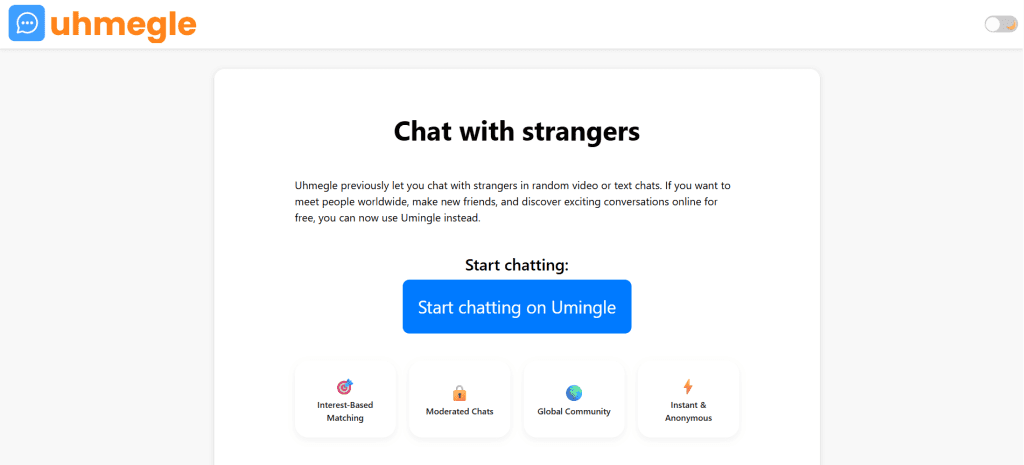
Most users will recognize the flow immediately. A typical session on a random video chat site follows a simple sequence:
- Open the website
- Choose text chat or video chat (if both are offered)
- Allow camera/microphone permissions for video mode
- Start a session and get matched with a stranger
- Continue chatting or skip to the next person
Some platforms in this category also offer interest tags, region preferences, or basic reporting tools. Those extras can improve the experience, but the core mechanic remains the same: instant random matching.
The appeal is obvious. There is no waiting for replies, no endless swiping, and no profile-building. A conversation starts in seconds. The downside is also obvious: randomness can be fun, but randomness can also be messy.
For that reason, users should treat every session like a live public interaction, even when the interface feels private.
Key Features and Standout Tools
Random chat sites often use similar marketing language, so the real test is whether the platform experience feels usable in practice. The most useful features in this category are not flashy extras. They are the tools that reduce friction and improve safety.
Common features users usually look for include:
- Instant matching: Start a chat quickly without complex onboarding
- Video and text modes: Flexibility for users who do not want to go straight to webcam chat
- Skip/next button: Essential for moving on fast when a chat is not a fit
- Reporting tools: Basic moderation support for abuse, spam, or inappropriate behavior
- Interest matching (if available): Helps reduce completely random mismatches
- Mobile browser support: Important for users who do not want an app install
A short practical point: the best “feature” on any stranger chat platform is often not a visible tool at all. It is connection quality. If the site loads quickly, starts chats fast, and does not constantly break the session, users are more likely to stay.
Is Uhmegle Anonymous?
Many people use random chat platforms because they want a low-commitment way to talk to strangers. That usually comes with some level of anonymity, but “anonymous” can mean different things depending on the platform setup.
In practical terms, users often mean:
- No public profile
- No need to share real name
- No social graph linking to friends/followers
- No visible chat history tied to a personal account
That does not automatically mean complete privacy.
A user can still reveal personal information during conversation. They can also be recorded by another person on the other side of the chat. Even if a platform does not force profile creation, an anonymous chat session can stop feeling private the moment someone shares a face, location clues, social handles, or contact details.
A good rule of thumb is simple: stranger chat can feel anonymous, but users should behave as if anything shown on camera could be saved.
Safety, Moderation, and Privacy Controls
This is the section that decides whether a random chat platform is “usable” for most people or only tolerable for a few minutes.
In this niche, safety is rarely perfect. The better question is whether the platform shows clear effort through moderation, user controls, and fast reporting paths. Users should look for signs like:
- Visible report/block buttons
- Community rules shown before or during chat
- Age-related guidance or restrictions
- Basic moderation messaging (human, automated, or hybrid)
- Clear warnings against harassment, nudity, scams, or abusive behavior
Even with moderation, random video chat platforms can expose users to:
- Spam or bot-like behavior
- Scammers trying to move chats off-platform
- Inappropriate content
- Harassment or abusive language
- Social engineering attempts
Privacy controls matter just as much as moderation. Before starting, users should check:
- Whether they can use text chat first
- Whether they can skip instantly
- Whether audio/video can be disabled easily
- Whether there is any sign-up requirement
- Whether the site explains data handling in plain language
If the platform is vague about privacy and reporting, that is a warning sign. Not always a deal-breaker, but definitely a reason to be cautious.
Pricing, Payments, and Subscription Structure
This category has a wide range of monetization models. Some platforms are mostly free with optional upgrades. Others are “free to start” but quickly push users into paid features, credits, or premium filters.
Because pricing structures can change, users should verify current details directly on the platform before paying. That said, random chat sites usually fall into one of these patterns:
- Free core access: Basic random chat with limited controls
- Freemium model: Free access plus paid filters or priority matching
- Credit-based system: Pay for specific actions or chat perks
- Subscription tiers: Recurring payment for premium features
What users should review before spending money:
- Is the price shown clearly before checkout?
- Is billing recurring or one-time?
- Are refunds explained?
- Are premium features actually useful (or just cosmetic)?
- Does free access remain usable without constant upsells?
A practical tip: test the free experience first. If the platform feels unstable, overly spammy, or low-quality before payment, paying usually does not fix the core problem.
User Experience (Mobile, Desktop, Sign-Up)
User experience can make or break a stranger-chat platform. Even a site with decent features can feel frustrating if the camera permission prompts fail, the “next” button lags, or the mobile layout is clunky.
Mobile experience
Many users now access random chat platforms from mobile browsers. A good mobile experience should provide:
- Fast loading
- Readable buttons
- Stable video window layout
- Easy mute/skip/report access
- Minimal pop-up interference
Desktop experience
Desktop still matters, especially for cam to cam chat users who prefer a larger screen. The most noticeable quality markers are:
- Stable connection handling
- Smooth switching between chats
- Clear placement of controls
- No confusing layered ads or misleading buttons
Sign-up flow
Low-friction access is a major reason people use these platforms. If sign-up is optional, users can test the environment without commitment. If sign-up is required, the platform should explain why and what benefits come with it.
In this niche, simplicity is a real product advantage. People generally want “click and chat,” not a five-step onboarding funnel.
Pros and Cons
No stranger chat platform is perfect for everyone. The value depends on what the user wants: fast casual conversations, text-first chatting, or a more filtered social experience.
Pros
- Fast entry into random conversations
- Low commitment compared with social or dating apps
- Usually easy to use without building a full profile
- Can be fun for short, spontaneous sessions
- Often offers both text and video modes
Cons
- Random matching can be hit-or-miss
- Safety and moderation quality may vary
- Some users may encounter spam, bots, or scams
- Free versions can be limited or ad-heavy
- Privacy depends heavily on user behavior during chats
A short honest summary: stranger chat platforms are best used with clear boundaries. They work well for quick conversations, but users should not expect consistent quality every time.
Uhmegle vs Alternatives
Anyone searching this niche usually compares multiple Omegle-style platforms before settling on one. The main differences are rarely dramatic at first glance, so users should compare on practical criteria:
- How fast chats start
- How often users run into spam
- Whether text mode is usable
- How easy it is to report or skip
- Whether filters are free or paid
- Overall moderation feel
A platform can look almost identical to competitors yet feel much better (or much worse) in actual use. That is why testing a few alternatives matters.
Popular comparison points in this niche often include:
- Mainstream random video chat sites with larger user pools
- Moderation-focused options with stricter rules
- Text + video hybrid platforms
- Filter-heavy platforms with more controls but more paywalls
Users who care most about safety may prefer a stronger-moderation platform, even if the user pool is smaller. Users who care most about speed may prefer a lighter platform with fewer filters. The “best” choice depends on the goal of the session.
Comparison Table: Uhmegle vs Other Platforms
| Platform | Best For | Free Version |
Moderation | Key Advantage |
|---|---|---|---|---|
| Uhmegle | Fast random video/text chats | Yes (typically basic access) | Medium (varies) | Simple Omegle-style start flow |
| OmeTV | Quick mainstream 1-on-1 chats | Yes | Medium | Large user pool and fast switching |
| Camsurf | Safer-feel random chat use | Yes | Stronger | Cleaner experience with visible reporting |
| Chatspin | Lightweight roulette chat + filters | Yes (limited) | Medium | Easy onboarding and optional filters |
| Camgo | Simple random chat sessions | Yes | Medium | Smooth start and straightforward UI |
| Emerald Chat | More structured matching | Yes (limited) | Medium–Stronger | Interest-style matching options |
| Joingy | Text + video flexibility | Yes | Medium | Quick mode switching |
| Shagle | Filter-oriented random chat | Limited / mixed | Medium | More matching controls |
How This Uhmegle Review Was Evaluated:
- Moderation strength
- Privacy/anonymity controls
- Pricing transparency
- Ease of use (mobile/desktop)
- Bot/spam prevention
- Filtering options (gender/location if relevant)
- Overall user safety
This evaluation framework is intentionally practical. It focuses on what users experience during actual sessions, not just what a landing page promises.
FAQs: Uhmegle
1. Is Uhmegle free to use?
It is generally presented as a free random chat platform to start with, but some platforms in this niche may limit certain features or add premium options. Users should check the current pricing page before paying for anything.
2. Do users need an account to start chatting?
Many stranger-chat platforms prioritize quick access and may not require a full account for basic use. If sign-up is requested, users should review what data is being asked for and why.
3. Can users choose text chat instead of video chat?
Platforms in this category often offer text and video modes, but availability can vary. Text mode is a useful option for users who want lower-risk, lower-pressure conversations.
4. Is Uhmegle safe for minors?
Random stranger-chat platforms are generally not suitable for minors because of the risk of inappropriate content, grooming behavior, scams, and exposure to adults. Parents and guardians should treat these platforms with caution.
5. Is it really anonymous?
It can feel anonymous because users often do not create public profiles, but anonymity is limited by what people reveal and what others record. Users should avoid sharing personal details or social handles.
6. Can people get scammed on random video chat sites?
Yes, scams can happen, especially when someone tries to move the chat to another app, asks for money, or pushes suspicious links. The safest move is to skip and report.
7. What should users do if someone behaves inappropriately?
Use the block/report tools immediately, end the chat, and avoid arguing. Fast exits are one of the most important safety features on stranger-chat platforms.
8. Does it work on mobile phones?
Most modern random chat sites aim to work in mobile browsers, but experience quality depends on device, permissions, and connection speed. Users should test camera and microphone permissions before starting.
9. Why do users see so many fake profiles or bots on some platforms?
Random chat niches attract spam and bot activity because of high traffic and low friction. Strong moderation and reporting tools help, but no platform removes the problem completely.
10. Are paid features worth it on stranger-chat platforms?
That depends on what the platform offers. If paid features improve filters, reduce spam, or improve matching quality, some users may find value. It is smarter to test free access first.
11. Can users be recorded during video chats?
Yes, another user can potentially record a session using screen capture tools or another device. Users should never assume a webcam chat is private just because it is one-on-one.
12. What is the best way to stay safe while using random chat platforms?
Use a nickname, avoid sharing personal details, skip fast, report abuse, do not click links, and keep conversations on-platform. Starting in text mode can also reduce risk.
13. How does it compare with Omegle alternatives?
The biggest differences usually come down to moderation quality, user pool size, filter options, and ease of use. Users should compare a few platforms rather than relying on branding alone.
14. Can users filter by gender or location?
Some platforms offer filters, but they may be limited, paid, or inconsistent depending on traffic. Users should check current feature availability directly on the site.
Final Verdict: Uhmegle
For users who want a quick, low-friction way to chat with strangers, this kind of platform can deliver the familiar Omegle-style experience: fast matching, simple controls, and immediate conversations. That said, the usual stranger-chat trade-offs still apply, especially around moderation quality, privacy limits, and inconsistent chat quality.
The best approach is to treat it as a casual social tool, not a fully safe or fully private environment. Test the free version first, keep expectations realistic, use strong boundaries, and skip/report aggressively when something feels off. For most users, the real question is not whether random chat is exciting, but whether the platform makes that experience safer and smoother. That is exactly how to evaluate Uhmegle.